Quick answer: To become a digital marketing freelancer, pick one service you can deliver well (like SEO or Meta ads), learn it through real practice, build 2–3 proof projects, set a clear package price, and pitch a small number of the right clients every day. Many beginners who follow this consistently land a first paying client within 1–3 months.
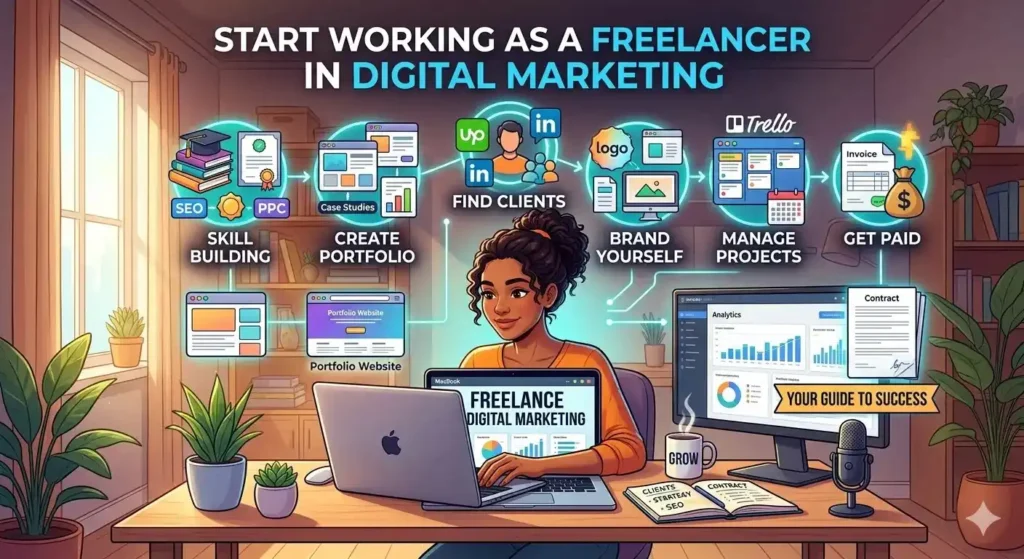
Table of contents
- Choose one service (your niche)
- Learn by doing, not just watching
- Build proof before you have clients
- Set up your freelancer toolkit
- Price your services
- Find your first clients
- Deliver, get reviews and scale
- FAQ
Step 1: Choose one service (your niche)
The biggest beginner mistake is offering “all digital marketing services”. Clients don’t hire generalists they don’t know — they hire someone who solves one specific problem. Start with one service, and ideally one type of client.
| Service | Good for you if… | Typical client |
|---|---|---|
| SEO | You like writing, research and slow, compounding results | Local businesses, blogs, service companies |
| Social media management | You’re creative and consistent with content | Cafés, salons, clinics, coaches |
| Meta / Google Ads | You like numbers and quick testing | E-commerce stores, real estate, education |
| Content writing / copywriting | You write clearly and quickly | SaaS, agencies, personal brands |
| Email marketing | You enjoy funnels and automation | Online stores, course creators |
Tip: Combine a service with a niche — “SEO for dental clinics in Kerala” is far easier to sell than “SEO services”.
Step 2: Learn by doing, not just watching
Free courses are enough to start. What matters is applying each lesson on a real website or account the same week.
- Free learning: Google Skillshop (Google Ads, Analytics), Meta Blueprint, HubSpot Academy, Semrush Academy, Google’s own Search Central SEO documentation.
- Practice project: Start your own blog or Instagram page and grow it. It becomes your first case study.
- Rule: For every hour of learning, spend at least one hour doing.
Step 3: Build proof before you have clients
Clients pay for results they can see. If you have no clients yet, create proof in other ways:
- Your own site or page: Show traffic growth from Google Search Console or follower growth from Instagram Insights.
- Free or low-cost project: Help one local business or friend for 30 days in exchange for a testimonial and permission to share results.
- Audit samples: Do a free SEO audit or ad account review for a real business and turn it into a portfolio PDF.
Put 2–3 of these on a simple portfolio page with: the problem, what you did, and the result (with a screenshot).
Step 4: Set up your freelancer toolkit
- Portfolio: A personal website (like this one) or a Notion / Google Drive portfolio.
- LinkedIn profile: Headline that states who you help and how — e.g. “SEO for local businesses | More calls from Google”.
- Freelance platforms: Upwork, Fiverr and Freelancer.com for global clients.
- Tools: Google Search Console, Google Analytics, Canva, a free keyword tool, Google Sheets for reports.
- Payments and paperwork: A simple proposal template, a basic contract, and an invoice format. Take an advance (commonly 50%) before starting.
Step 5: Price your services
Sell monthly packages with clear deliverables instead of hourly rates. It’s easier for clients to say yes and gives you steady income.
| Service | Example monthly package |
|---|---|
| Local SEO | Google Business Profile, on-page fixes, 4 blog posts, monthly report |
| Social media | 12 posts, captions, basic engagement, monthly report |
| Meta ads | Campaign setup, 2 creatives, weekly optimisation, report (ad spend paid separately) |
Start with a fair beginner price, deliver great results, and raise your prices after every 2–3 successful clients.
Step 6: Find your first clients
- Warm network first: Tell friends, family and past colleagues exactly what you do. First clients very often come from here.
- Local businesses: Find businesses with weak Google Business Profiles or inactive Instagram pages and send a short, personalised message with one specific improvement.
- LinkedIn: Post 3 times a week about what you’re learning and doing; comment on posts by business owners in your niche.
- Freelance platforms: Send 5 tailored proposals a day on Upwork, or create 2–3 specific Fiverr gigs.
Simple outreach message:
Hi [Name], I noticed [business] isn’t showing in the Google map results for “[service] in [city]”. I help local businesses fix this. I made a quick 3-point checklist for your profile — can I send it over? No charge.
Step 7: Deliver, get reviews and scale
- Send a short monthly report: what you did, results, next steps.
- Ask every happy client for a written testimonial and a referral.
- Turn each successful project into a case study on your site.
- Once you’re fully booked, raise prices, niche down further, or outsource simple tasks.
Common beginner mistakes to avoid
- Offering every service instead of one.
- Working without an advance payment or written scope.
- Promising guaranteed rankings or “viral” results.
- Spending months on courses without doing real projects.
- Charging too little for too long.
If you plan to offer SEO, read the hidden SEO mistakes that kill website traffic — fixing these for clients is one of the easiest ways to show quick results.
FAQ
Can I become a digital marketing freelancer without experience?
Yes. Start with your own project or a free project for a local business so you have proof. Clients care more about results and communication than certificates.
How long does it take to get the first client?
With daily outreach and 2–3 proof projects, many beginners get their first client within 1–3 months. It depends on your niche and how consistently you pitch.
Which digital marketing skill is best for freelancing?
SEO, paid ads and social media management are the most in demand. Pick the one you enjoy doing every day, because consistency matters more than the skill you choose.
Do I need a website to start freelancing?
No, but it helps. A simple portfolio site with case studies builds trust and can bring clients from Google over time.
How much can a digital marketing freelancer earn in India?
It varies widely by skill, niche and client location. Beginners usually start with small monthly retainers and grow income by adding clients, raising prices and working with international clients.
Final thoughts
Freelancing in digital marketing isn’t about knowing everything — it’s about solving one problem well for one type of client, showing proof, and following up consistently. Pick your service today, start one proof project this week, and send your first five pitches.
Pingback: Website Traffic Dropping? 10 Hidden SEO Mistakes to Fix in 2026 - Sreelekshmi A